See Our Latest Blogs- Coming Soon
The Man We Pretended To Be
The Man We Pretended To Be
You didn't choose the version of masculinity you inherited. Neuroscience and Buddhist philosophy both suggest something unsettling — and liberating: the man you think you are was always a construction. In mid life, you can finally build a better one.
I learnt a profound lesson about being a man from my Dad. Don’t express emotion, don’t let it in. Love and attachment are a world of pain. Better to keep that stuff locked away.
And so for me, to quote some common wisdom, the longest journey I’ve ever made — longer than all the trips I’ve done to all ends of the planet — has been from the head to the heart. Anger has come easily but intimacy, compassion, love have been challenging.
We learn about being in the world from our parents. Dad didn’t mean to teach me this lesson. He was a product of growing up in the Depression years, being separated from his family and losing his mother when he was still in his teens.
Men of his generation weren’t supposed to express emotion. They were meant to be stoic — in the narrow not the philosophical sense of the word — and in control.
Phillip Larkin wrote: "They fuck you up, your mum and dad. They may not mean to, but they do. They fill you with the faults they had and add some extra, just for you."
I wouldn’t say Dad fucked me up. That would be unfair. But he helped me to develop a way of being in the world that hasn’t always served me. I observed a man uncomfortable with emotions, except anger, and I learnt to suppress mine.
So I developed a strategy. I learnt to distract myself with the next best thing, the next best opportunity. In my twenties the pattern was set. I travelled outwards; I lived overseas: in Zimbabwe, Canada, Peru, Bangladesh, looking for answers my father and his predictable, solid suburban existence couldn’t give me. Life that had zing. Perhaps what I needed was to sit in one place for a while and do a bit of excavating.
What neuroscience now confirms is something Buddhist monks worked out 2,500 years ago: the self you experience as fixed and real is, in fact, constructed — assembled moment by moment from habit, memory, and narrative.
The brain builds you — and keeps rebuilding
The good thing about travel is that it has set me in motion. The physical journey has become the spiritual quest
There’s a wonderful quote from Cleaver Greene the character in the television series Rake. He’s a hard-nosed, cynical bugger and at one point he turns to his son with some words of wisdom. And here I’m paraphrasing:
Son, I've spent my whole life on a journey to find out who I am and I've discovered it wasn't worth the trip.
I include that for some gratuitous humour, but maybe Greene was making the point that the self is not something to be found.
The neuroscientist Antonio Damasio describes the self not as a thing but as a process — a continuous story the brain tells about who we are, edited and updated constantly based on experience. What feels like our personality is, at the neural level, a set of deeply grooved patterns: predictive models the brain runs to make sense of the world and our place in it.
These patterns are not fixed. The brain's neuroplasticity means that how we think, respond, and identify can genuinely change across a lifetime. The man we were at 25 does not biologically determine the man we will be at 45. But — and this is the part many of us miss — change requires first recognising that the current version of ourselves was constructed in the first place.
We cannot update a programme we believe is real.
The ancient insight that neuroscience just caught up with
In Buddhist philosophy, the concept of 'no-self' points to the same recognition. What we call the self is not a fixed, essential thing. It is a flowing process of perceptions, sensations, and mental habits that we fictionalise as a consistent 'me.'
This is not a counsel of despair. It is an invitation. If the self is constructed, it can be reconstructed. If personality is a story, we can become a more conscious author of it.
The Zen teacher Shunryu Suzuki put it plainly: in the beginner's mind there are many possibilities; in the expert's mind there are few. The man who believes his identity is fixed — who says 'that's just who I am' — has closed the very doors that midlife is trying to open.
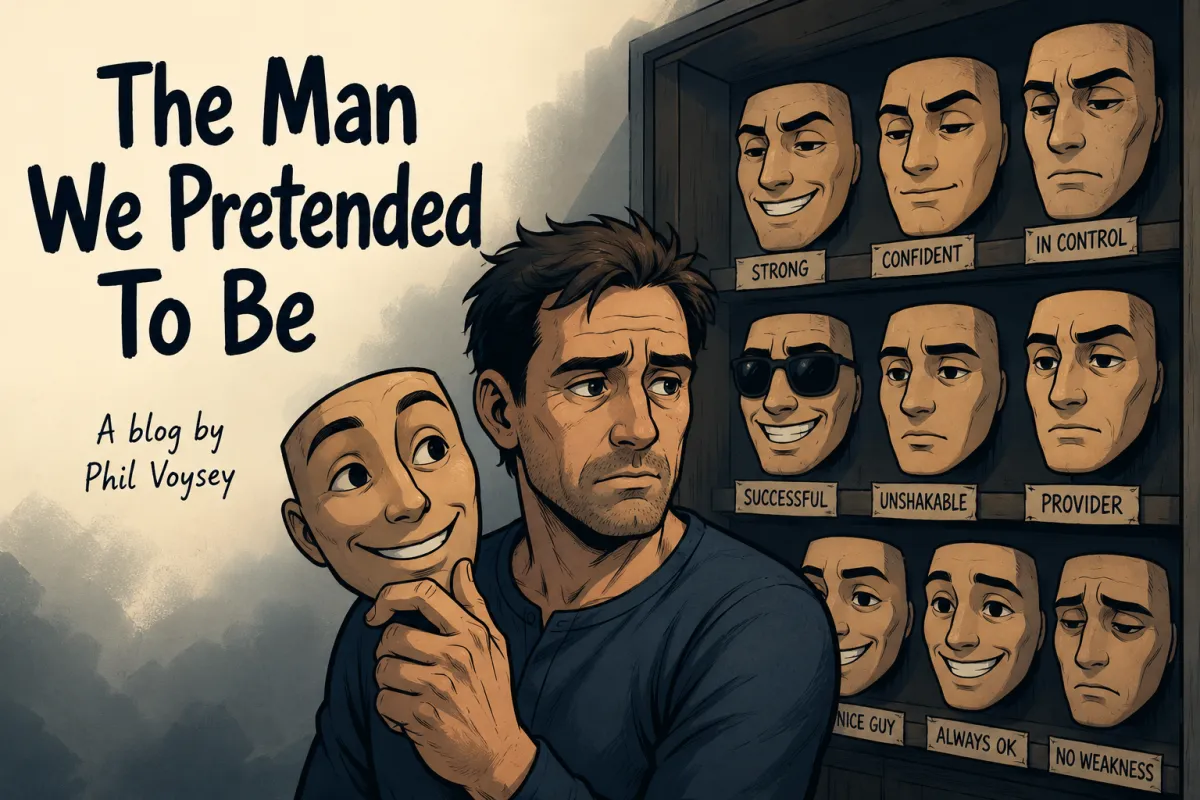
The mask had become the face. Midlife's great gift is that it starts to slip — and for the first time in decades, we can see the gap between the two.
The inherited blueprint
Traditional masculinity gave men a clear script: be strong, be stoic, provide, protect, dominate uncertainty. For most of human history, this script was adaptive. It worked. And parts of it — resilience, responsibility, protective instinct — are genuinely worth keeping.
But the script also demanded that men amputate whole dimensions of themselves. Vulnerability. Emotional range. Uncertainty. Tenderness. The need for connection that wasn't mediated by achievement or usefulness.
By mid-life, most men are carrying the cost of that amputation — in bodies that are tighter than they should be, in marriages that are polite and distant, in friendships that never go below the surface, in a private sense that something essential has never been allowed to breathe.
The research backs this up. Men over 45 show significantly higher rates of depression, alcohol dependence, and suicide than women in the same cohort — and significantly lower rates of help-seeking. We built a version of masculinity that is quietly killing the men performing it.
The man we could choose to be
Here is what makes midlife different from any earlier moment: we have enough life behind us to see the pattern, and enough ahead of us to do something with that knowledge.
The question is not 'who am I really?' as if there is some essential, authentic self waiting to be discovered. The neuroscience and the Buddhist traditions agree: there isn't. The question is more honest than that.
Which parts of the man I constructed still serve me — and which parts did I build to survive a world I no longer live in?
The version of masculinity we inherited was built for someone else's life, in someone else's era, probably by men who were themselves performing a script they never chose. We don't have to burn it down. But we do have to look at it clearly.
The self is not a prison. It is a practice. And in mid life we are experienced enough to practise it differently.
I can’t resist ending with another Cleaver Greene quote:
"You can't try a life, you've got to live an authentic one. Mine might be anarchic, catastrophic, without rhyme or reason... but f** me, it's real."*
This is part of a series using the Hero's Journey as a framework for men navigating midlife. The next piece explores what your body is trying to tell you before your mind catches up.
Which part of the masculine script have you found hardest to question? I'd like to hear it in the comments.
Phil Voysey is the Founder of Possibility of Us: www.possibilityofus.com.au
What others are saying
Education. Inspiration. Transformation.
Empowering you to flourish in the second half of life with the tools, experiences, and support to create lasting change.
© 2026 Possibility of Us - All Rights Reserved