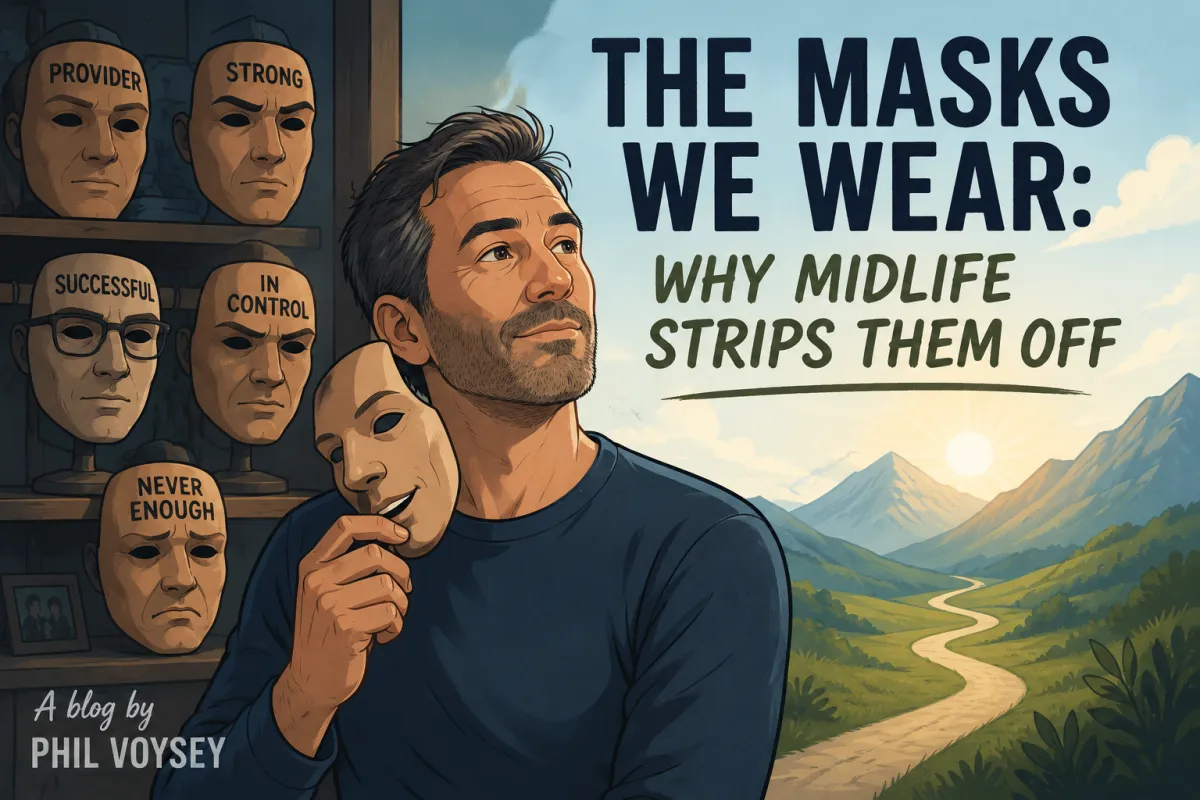
The Masks We Wear: Why Midlife Strips Them Off
The Masks We Wear: Why Midlife Strips Them Off
The psychological process of persona dissolution isn't a breakdown. It's a developmental event — one that is not only inevitable, but necessary.
I never imagined I'd reach my sixties and be writing novels, performing original songs on my Gretsch guitar and learning how to run a business.
This was not my story. In my 20s I was the cricketer, footballer and traveller. In my 30s and 40s I was the teacher and development worker, spurred on to make the world a better place. A bit of a self-righteous do-gooder if the truth be known, for whom the world of business was anathema. It signified greed and I wasn't cut out for business in any case.
Then I became a husband and father, and was challenged to get out of my head and into my heart. I've always been a bit of a weepy type. This reached new levels watching father daughter films — Parent Trap, What a Girl Wants — with my young daughter. My sentimentality has never ceased to amuse her: Dad tearing up over a clichéd Hollywood movie. Hilarious.
Like all of us, I’ve had multiple identities. As Walt Whitman[1] wrote: Do I contradict myself? Very well, I am multitudes.
And of course we are. And those multiple selves? They are all just stories. And as a writer I know that most stories can be rewritten and take on new life with a good edit.
The Fake You
In 1921, Carl Jung introduced a concept he called the persona — the Latin word for the mask worn by actors in classical theatre. The persona, he wrote, is the face we construct for the world: a system of adaptive responses, social roles, and acceptable behaviours assembled over years of navigating family, culture, and professional life.[2]
It is not a lie or a fiction, exactly. It is a simplification. A selection of traits that proved useful, amplified and rehearsed until they feel like the whole story. The persona is what we present; the self is what remains when the presentation stops.
For most of us, the persona is built in earnest between the twenties and early forties. The professional identity, the social role, the emotional register deemed appropriate for a man in our world. By forty-five, it fits like a suit worn for twenty years — familiar, slightly too tight, and in need of replacement.
Then something happens. A redundancy. A divorce. A health scare. Or more quietly: a Sunday afternoon in which the absence of any crisis makes the hollowness somehow louder. The persona, which required constant external reinforcement to maintain, starts to lose its structural integrity.
This is not a crisis of identity. It is the beginning of a more honest encounter with one — the slow, disorienting, necessary process of discovering what lies beneath the mask.
What's Going On?
Neuroscientist Antonio Damasio makes a distinction between the core self — the immediate, pre-narrative sense of being a subject of experience — and the autobiographical self — the constructed story we tell about who we are across time. The persona lives in the autobiographical self. It is a narrative structure, maintained by memory, habit, and social feedback.[3]
What neuroimaging research reveals is that the default mode network — the brain's self-referential processing system, active when we're not focused on external tasks — is essentially the organ of persona maintenance. It is where the internal monologue runs, where identity is rehearsed, where the story of 'me' is continuously updated and defended.[4]
Philosophers, spiritualists and poets echo this idea of a constructed self. Buddhism, pre-dating neuroscience by 2500 years, sees identity or the self as a flowing process of aggregates: form, sensation, perception, mental formations, consciousness. None of these, examined closely, turns out to be the stable 'I' we assume ourselves to be.[5]
The self exists, but not in the way we think. It is a process, not a possession. A verb, not a noun. And crucially: recognising this does not destroy the self. It liberates it from the compulsive defending of a fiction.
This realisation might come through a practice of meditation, self-enquiry, journalling, or be catalysed by a challenge of some sort. The important thing is that this feeling of disorientation and dissolution — who the fuck am I and what am I supposed to do with my life? — is not a crisis. It is the precise moment we have the cognitive and emotional complexity to see through our own construction. Although it feels like falling apart, it is actually moving forward.
The mask doesn't fall off because something has gone wrong. It falls off because we have finally grown large enough to see that we were wearing one.
So, what?
So, what do we do with this realisation?
We can opt to do nothing and fall back into familiar patterns and habits, the ones that kept us feeling stuck and unfulfilled in the first place. Or we can reconstruct a slightly updated version of the old mask and call it growth.
What is really required, though, is what the Persian poet Rumi called tearing down the house, the house being the metaphor for the structures that keep the old self in place. If we want to get to the good stuff, the possibility of who we might be, then we have to do the work, we have to excavate.[6]
That requires practice. Therapy, coaching, contemplation, honest relationships, sustained inquiry. Not self-improvement. Self-dissolution, followed, gradually, by something more coherent than what came before.
The goal is not to find yourself. The goal is to stop being so afraid of the space where the self used to be, because it is in that space that something real has room to grow.
The invitation
When the mask begins to slip in midlife, the instinct is to press it back into place. To work harder, achieve more, perform louder. The danger is not the dissolution of identity but the re-construction of a smaller sense of who we are.
The persona was always a beginning, not a destination. It got us here. What gets us through the second half of life is something that doesn't need a mask, because it has nothing left to hide.
This is part of a series using the Hero's Journey as a framework for men navigating midlife. References are footnoted above for those who want to go deeper.
At what point in your life did you first sense a gap between the person you were performing and the person you actually were? I'd be interested to hear.
Want help putting a practice in place to help you drop the mask and rewrite your story?
Let's talk: Book a Life Design Coaching session
Phil Voysey
Life Design Coach, Facilitator
Author of:
Ageing (dis)Gracefully: How to Flourish in the Second Half of Life
Workbook: Meaning, Vitality and Joy in the Second Half of Life
*This piece is part of a series developed in dialogue with Claude, an AI assistant. The intellectual direction, lived experience and editorial voice are mine — Claude helped me find the words.

