Peru:The Virtue of Slowing Down
Peru: The Virtue of Slowing Down
I'm an impatient bastard. Always have been.
Queues make me twitch. My blood pressure rises waiting for anything — and that's despite the meditation and yoga.
But the moment I land in Lima, something shifts. Peru puts its arm around me and says: "Hey Phil, you're here now. Slow down amigo. You're on Peruvian time."
And I do.
I'm remembering the 18-hour bus trip across the Andes from Nazca to Cusco in the wet season — only a good idea if you like thrills. Frequent stops to clear rockfalls. Hairpin bends negotiated ever…so…slowly so as not to tumble into the abyss.
And then there was applying for residency while running a home for street kids. Multiple signatures. Plodding from one government office to another. Until the secret police — Policia Investigativo Peruano, or PIP (appropriately pronounced PEEP) — lost my passport.
The head of the PIP had a revolver on his desk pointing straight at me while I explained my situation. He barked an instruction. Underlings scrambled. Passport found.
This was the late 80s, at the height of Shining Path terrorism. Fear and suspicion were as thick in the air as the smell of barbecuing chicharones on street corners.
Peru teaches you to suspend judgement and expectation. And that's a good thing. What are expectations, anyway, but a shitload of disappointment waiting to happen?
When you arrive, look for the Expectations Bin and dump yours in there.
Be open. Because anything is possible — a mind-altering experience (probably the ayahuasca), falling in love with a local as I did, the Andes whispering profound things in your ear, or UFOs darting across the night sky. I can't otherwise explain the zig-zagging, jumping, darting bright object I saw one night in the Sacred Valley.
Being at altitude in Cusco (3,400m) and the Sacred Valley (2,800m) is transformational in itself. It forces you to slow down. Your legs are heavy on the stairs. Your breathing quickens. You stop. You rest. You pay attention.
That's the whole experience, right there.
One traveller said to me halfway through the Inca Trail: "I feel like I've finally caught up with myself."
That's what slowing down does. It doesn't give you more time. It gives you a different relationship with it.
Machu Picchu lands differently when you've taken the time to arrive.
Maybe that's the real invitation — not just to travel, but to remember what it feels like to move through life at a human speed again.
I lead small-group journeys to Peru for people ready to travel differently. Reach out: [email protected]
Walking Slower Than the World Tells You To
There's a moment I think about often.
Early morning in Peru's Sacred Valley. The group has gone quiet — not because I've asked them to. Because the place itself asks for it. Light arrives slowly over the mountains. The air is cold enough to feel in your chest. You can hear your own breathing.
Nobody is in a hurry.
It lasts maybe two minutes. And then, gently, the world starts moving again.
But those two minutes — I keep returning to them.
We've become very good at motion. At filling every available space with input, doing, reacting. Even travel has been captured by it: see this, tick that, post it, move on.
Peru resists that. Not aggressively — it's not a place that lectures you. It just quietly refuses to reward the pace most of us arrive with.
The journey I lead there is built around something different: human pace. Not slow tourism. Not unplugged-for-the-sake-of-it. Just a tempo where things can actually land.
At Maras — thousands of salt pools cascading down the hillside, still harvested by hand by the same families across centuries — you can photograph the view and be back on the bus in ten minutes. Or you can stay. Watch how people move. Notice the rhythm of work that was never designed for efficiency, only for continuity.
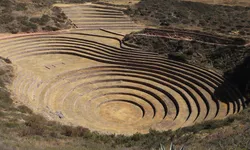
At Moray, those extraordinary circular terraces descending into the earth, the Incas ran agricultural experiments — testing how crops responded to different microclimates. They were building an empire, yes. But they were also just paying close attention.
Both places give you something to look at. What they really offer is a mirror.
Halfway through one journey, a woman in the group said something I've never forgotten.
"I feel like I've finally caught up with myself."
She didn't say it dramatically. More like noticing something that had been true for a while.
That's the thing about slowing down that's hardest to explain in advance: it doesn't give you more time. It gives you a different relationship with the time you have. You stop experiencing it as something you're running behind on.
By the time Machu Picchu appears — and it is, without question, spectacular — it lands differently than it would have on day one. Not because it changes. Because you have.
The world has a pace it would very much like you to keep.
Peru gently suggests you don't have to.
I lead small-group journeys to Peru for people ready to travel at a different speed. If this landed with you, I'd love to hear from you.

