Peru: The Place That Waits for You
Peru: The Place That Waits for You
I didn’t plan for Peru to become part of my life.
Then again, most things that matter don’t arrive through careful planning.
They sneak in sideways while you’re busy doing something else.
Life is what happens when you’re busy making other plans, as John Lennon put it.
Back in 1985, I arrived in Cusco slightly dazed, lungs working overtime in the thin air, wondering what the hell I was doing there.
I had no grand plan.
No spiritual awakening pencilled into the itinerary.
Just a backpack and a guitar, a bit of curiosity, and a quiet suspicion that life might be bigger than the one I’d been living.
Cusco hit me immediately.
Partly, it was the altitude, 3,500 metres will do that to you. I felt like I was breathing through a straw and walking in ski boots.
But it was something else too. The city itself. Colonial buildings sitting on foundations of perfectly cut Inca stone. Two worlds clashing, one trying to erase the other, and somehow both still present.
I remember wandering those cobblestone streets on that first day, slightly lost, slightly overwhelmed, and having this unexpected thought: I’ve arrived exactly where I’m meant to be.
Not because I understood it. But because I didn’t.
I was supposed to keep travelling. Head south into Chile and Argentina. That was the plan. But plans have a habit of dissolving when something more interesting comes along.
So I stayed. What followed wasn’t a trip. It was a life.
I lived with a local family and learned Spanish, badly at first, then slowly better. I fell in love with a local woman. I ran a home for street kids. I helped a Quechua friend put a roof on his house—my heavy feet punching holes through the bamboo frame while everyone else laughed and shook their heads.
I spent a week harvesting maize in a remote community, battling flies, heat, and my own romantic ideas about “simple living.”
There’s nothing romantic about harvesting maize under a Peruvian sun at 3000 metres. But there is something deeply real about it.
That was over forty years ago. And I’ve kept going back.
Cusco became my second home, my Cusqueñan family became my second family. The street kids are now adults with lives of their own, but the connection remains.
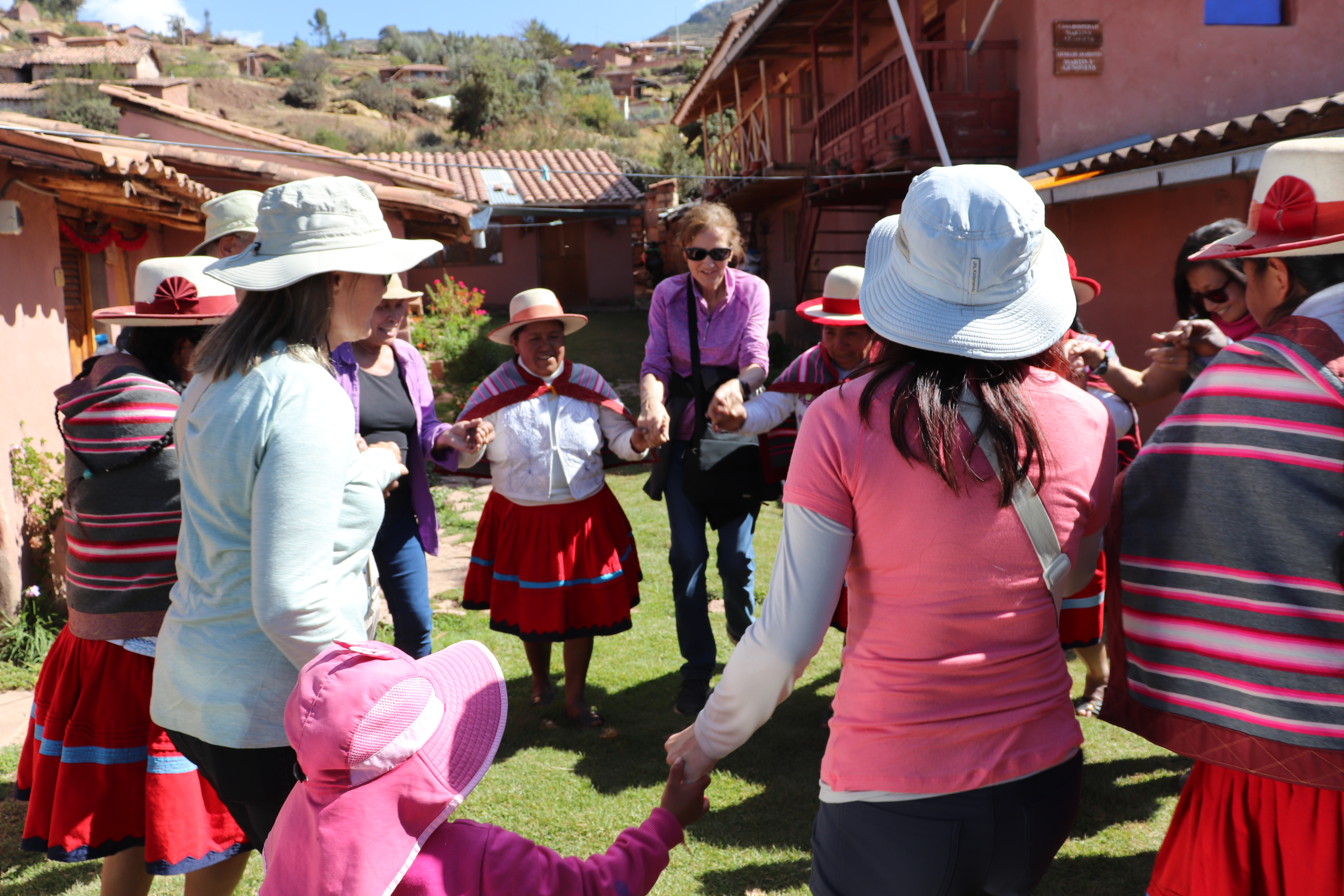
These days, one of my great joys is bringing others there. Not to show them Peru. But to let Peru reveal itself to them.
We begin in Lima—a city of layers. Colonial grandeur sitting on top of ancient civilisations like Huaca Pucllana, a quiet reminder that what you see is never the whole story.
And then we move to the Sacred Valley. And something shifts.
We wake early. The air is crisp. The Andes rise around us like guardians, apus in Quechua.
There’s no rush. No need to tick anything off. Just space. To breathe again, literally and metaphorically.
And in that space, things begin to settle. It happens quietly. Between the mountains.
In conversations over long meals. In moments where no one feels the need to fill the silence.
Not answers. But clarity. A remembering.
I’ve seen it many times now. People arrive carrying something they can’t quite name. A question. A restlessness. A sense that something in their life is slightly out of alignment.
And somewhere along the way that tightness loosens.
Not because Peru fixes anything. But because it creates the conditions for you to see more clearly.
That’s why I’ve come to think of Peru not as a destination, but as a mirror.
It reflects something back to me.
And if Peru has been sitting quietly in your mind—or tugging at you in some small, persistent way—there’s usually a reason.
The question isn’t really:
Should I go?
It’s more like:
What might be waiting for me there?

