Peru: The Joy Of Sadness
PERU: The Joy Of Sadness
The Beauty of La Tristeza:
How Andean Sadness Became an Art Form
In the highlands of Peru, melancholy is not something to be overcome. It is something to be worn, sung, and woven — a philosophy written into every thread and every note.
In Western culture we label sadness as a negative emotion. We overcome it, we push it away, we suppress it, we get over it, we move on. Don’t be sad. Don’t worry, there’s always a ‘light at the end of the tunnel’, ‘one door closing another door opening’, ‘something better around the corner’, or worst of all ‘a reason why it happened’, whatever it happened to be.
People said these things to me when I was experiencing a profound sadness from being made redundant from my dream job. I wanted to tell them all to fuck off. What I needed someone to say was: ‘Redundancy is shit. You feel sad. Be sad. Wallow in it baby.’
Sadness gets a bad wrap. As if there’s something wrong with being sad.A neuroscientist would reject the negative label. Sadness is just an emotion. Like happiness or joy it is not a permanent state. It comes and goes. It is part of life and not something to be avoided.
This is one of the things I truly love about Peru. Peru taught me that sadness is not only ok, it is a thing of beauty to be celebrated.
La Tristeza as it’s called, carries the weight of sadness, but also of longing, of a grief that is held rather than released, of an ache that is considered inseparable from love and from beauty.
To understand Peru — its music, its textiles, its festivals, its silences — one must first understand that la tristeza is not a wound. It is a way of seeing. It is, in the truest sense, an aesthetic. It is woven into the fabric of life.
"Melancholy in the Andes is not the absence of joy. It is the depth from which joy becomes possible — the shadow that gives colour its meaning."
The Thread That Carries Memory
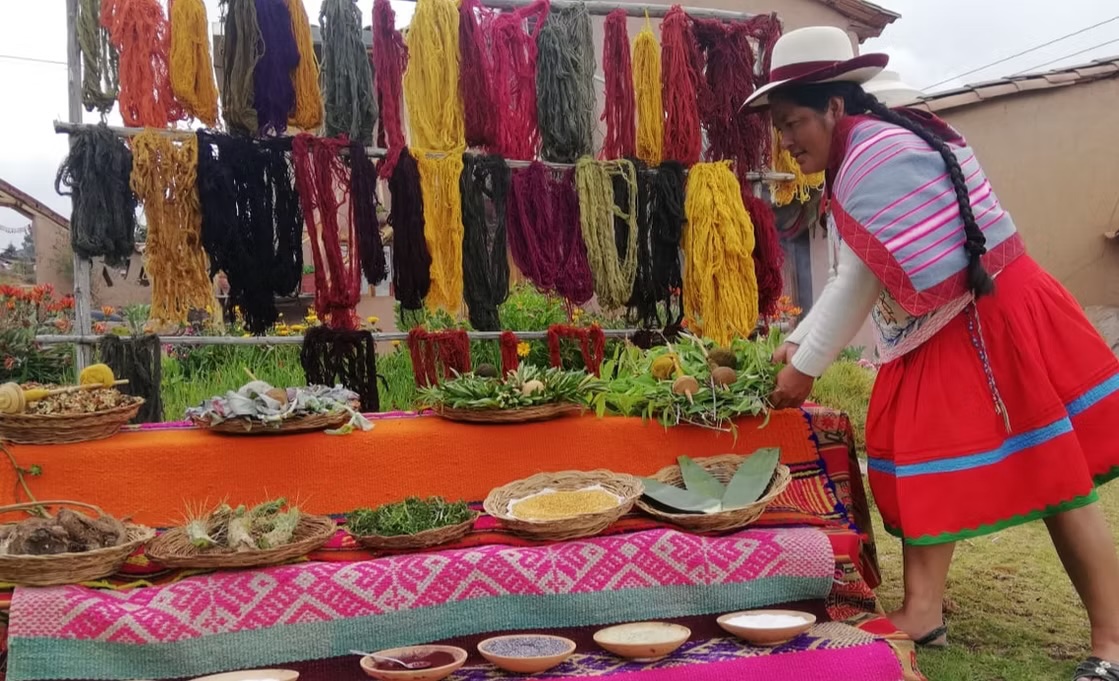
Stand before a Peruvian textile from the southern highlands — a manta from the Chinchero weavers, or a ceremonial cloth from Taquile Island on Lake Titicaca — and you are standing before a document. Not of facts, but of feeling. Andean weavers do not merely create objects. They encode cosmology, ancestry, and emotion into every row of thread.
The colour palette itself speaks of tristeza. Deep indigo from the añil plant, cochineal reds. The black of alpaca wool that has never been touched by dye — black that the weavers call the colour of the Pachamama's night, the earth at rest, the world between worlds. These are not the cheerful colours of decoration. They are the colours of a people who learned, over centuries, to keep beauty close to grief.
The iconography reinforces this. Andean textiles are populated with the chakana — the Andean cross, a symbol of the three worlds: the world above, the world we inhabit, and the world below, the realm of the dead. This vertical axis of existence, in which the living are perpetually in conversation with their ancestors, is not morbid in Andean understanding. It is simply true. The dead are present. La tristeza of their absence is balanced by the comfort of their nearness.
Music as Held Weeping
If the textiles carry la tristeza in colour and form, Andean music carries it in sound. The huayno — the traditional song form of the Peruvian highlands, sung in Quechua and Spanish— is the most intimate musical expression of Andean melancholy. Its rhythms are quick, its melodies often bright and joyful, yet its emotional register is almost invariably one of longing: for a lost lover, for a home left behind, for the dead who walk beside us, for a world that was taken.
Often the lyrics are playful, laughing at a drunk and/or cheating spouse. Sitting on a bus to Paucartambo I heard a man sing a huayno with a lyric that sent the bus into hysterical laughter:
De la cintura para arriba soy casado contigo
De la cintura para abajo soy soltero, soltero para siempre
From the waist up I’m married to you
From the waist down I’m single, always single
This is not a paradox. The juxtaposition of the music and the sentiments of the song reflects something central to Andean life: grief and movement must coexist, we must carry our sorrow with us as we work, as we dance, as we plant the earth. The huayno does not ask us to sit still with our sadness. It asks us to move with it, and sometimes to laugh at it.
The huayno does not ask us to sit still with our sadness. It asks us to move with it, to carry it into the field and into the festival, into the body of the living day.
The History Inside the Sorrow
The great Peruvian poet Cesar Vallejo writes in his poem Dark Riders:
There are blows in life so violent— I can’t answer
Blows as if from the hatred of God; as if before them,
the deep waters of everything lived through
were backed up in the soul…I can’t answer!
Peruvian life and history is filled with ‘blows so violent I can’t answer’. There are the everyday blows. The corruption of politicians — as I write Peruvians are voting for their ninth President in ten years. The struggle to make ends meet for much of the population. It’s in the eyes of street kids high on glue and the shoeshine boy who told me he was cleaning my shoes with his tears. I heard it in the voice of the mother who asked me to take her child, disabled by burns from head to foot from falling into a kerosene stove, to a better life than the one she could give her. I saw it in the eyes of my host father Jose as he spoke wistfully about his life as a land owner before the land reform of 1969 took it all away. The reform was just; it ended 400 years of feudalism. But understanding who wins and who loses and what is just is never easy when history turns the page. Jose not only lost his land, he lost his soul.
Then there is history. The Andean peoples carry within their cultural memory one of the most catastrophic encounters in human history: the collapse of the Incan empire under Spanish conquest, the decimation of the population by disease and violence, the systematic destruction of temples and sacred sites, the imposition of Catholicism, the forced labour of indigenous people in mines and on estates owned by landowners. More recently the brutal civil war with the Shining Path in the 1980s and 90s killed 70,000 and displaced more than half a million people leaving a dark stain on the country’s history.
This is what cultural theorists sometimes call historical trauma — grief that passes through generations not as explicit memory but as orientation, as a particular quality of attention to the world's beauty and its losses. It manifests in the specific way Andean communities celebrate the dead at Día de los Muertos, not with formal solemnity but with food and music and the genuine belief that the boundary between living and dead is permeable and negotiable. It manifests in the profound attachment to place —to the mountain, the apu, which is both ancestor and deity — that makes migration from the highlands such a particular kind of grief, the kind that settles in the body and changes the colour of every joy thereafter.
But this is not a culture defined by victimhood. Salucha por la lucha la lucha de la vida – Cheers to the struggle, the struggle of life — says my Quechua friend Simon as he downs another chicha after thrashing me at sapo yet again.
The Andean understanding of sorrow carries within it an extraordinary dignity, a refusal to be diminished by grief. The textiles keep being woven. The huaynos keep being sung. The mountains keep being honoured. In the face of what was taken, what was not taken is tended with a devotion that is, itself, beautiful.
What the World Might Learn
Contemporary Western culture maintains an embattled relationship with sadness. We are exhorted to recover from it, medicate it, reframe it, overcome it. We speak of wellbeing as the presence of positive emotion and the absence of negative emotion. Sadness is a problem to be solved.
The Andean understanding offers something different, not as exotic wisdom to be appropriated, but as a genuinely alternative philosophical position worth considering. In this understanding, sadness is not the opposite of a good life. It is the depth of a full life. La tristeza is what happens when you love something enough to feel its loss. The capacity for grief is the capacity for attachment, and the capacity for attachment is the capacity for meaning.
"The capacity for grief is the capacity for attachment. The capacity for attachment is the capacity for meaning. La tristeza, in the end, is the shape that love takes when it lasts."
La tristeza, then, is not melancholy as paralysis or as illness. It is melancholy as a form of intelligence — a sensitivity to time, to loss, to the way that beautiful things are always, in some sense, already passing. The Andean weaver who spends months on a single cloth is, among other things, performing an act of resistance against impermanence. The musician who plays the quena at a funeral is not merely mourning. He is insisting that the dead person was real, that their absence matters, that grief is the correct and dignified response to a world in which everything we love will eventually become memory.
And perhaps that is what la tristeza ultimately teaches: not how to be sad, but how to be present, to stand in the full weight of what has been, and what has been lost, and to find in that weight not despair, but beauty. To weave it. To sing it. To carry it, in colour and in sound, into a world that badly needs to remember that grief, held with grace, is one of the most human things there is.
*
The instruments themselves are built for sorrow. The zampoña, or panflutes, can produce lively sweet melodies or deep resonant sounds that seem to rise up from the bowels of the earth. The quena, the Andean flute carved from reed or bone, produces a tone like the sound of the wind through a high mountain pass — vast, cold, and heartbreakingly beautiful. Traditionally, the quena was said to have been made from the bones of a beloved who had died. The instrument was the grief made audible, the beloved given breath again. Even today, played at altitude with the Andes spread below and clouds overhead, the quena's sound seems less like music than the landscape itself discovering it has a voice.
Strictly speaking neuroscience tells us that there is no such thing as negative emotions. Just emotions. The aim of life is not to live life blissfully happy — happiness is just a temporary state — but to experience the full range of human emotion, to experience what it is to be fully human.
The Every Day Sadness
The great Peruvian poet Cesar Vallejo writes in his poem Dark Riders:
There are blows in life so violent— I can’t answer
Blows as if from the hatred of God; as if before them,
the deep waters of everything lived through
were backed up in the soul…I can’t answer!
He wasn’t only referring to the big upheavals of history: the Spanish conquest of 1532 , the bloody civil war in the 1980s and early 90s with the Shining Path that killed 70,000 and displaced half a million people.
Sadness is woven into the every day. It is in the day to day struggle to make ends meet, the harshness of spending lives walking mountain trails under a harsh sun. It is in the faces of orphaned children, a family grieving the loss of their daughter in a tragic car accident, children orphaned by the death of their father from alcoholism and their mother in childbirth, the distress of mothers trying to create better lives for their children severely disabled with burn scars from falling into wood and kerosene stoves in remote communities where there was no ready access to medical facilities. .
Love and loss are so intertwined. I recall the wistful eyes of my host father Jose as he recounted his life as a land owner before the land reform of 1969 took it all away. The reform was just; it ended 400 years of feudalism. But understanding who wins and who loses and what is just is never easy when history turns the page. Jose not only lost his land, he lost his soul.
The Beauty of La Tristeza: How Andean Sadness Became an Art Form
In the highlands of Peru, melancholy is not something to be overcome. It is something to be worn, sung, and woven — a philosophy written into every thread and every note.
There is a word in the Quechua language — llaki — that does not translate cleanly into English. It carries the weight of sadness, certainly, but also of longing, of a grief that is held rather than released, of an ache that is considered inseparable from love and from beauty. When Spanish colonisers arrived in the sixteenth century, they brought their own word: tristeza. The Andean peoples absorbed it, but the feeling it named was already ancient, already woven into the very fabric of their world.
To understand Peru — its music, its textiles, its festivals, its silences — one must first understand that la tristeza here is not a wound. It is a way of seeing. It is, in the truest sense, an aesthetic.
"Melancholy in the Andes is not the absence of joy. It is the depth from which joy becomes possible — the shadow that gives colour its meaning."
The Thread That Carries Memory
Stand before a Peruvian textile from the southern highlands — a manta from the Chinchero weavers, or a ceremonial cloth from Taquile Island on Lake Titicaca — and you are standing before a document. Not of facts, but of feeling. Andean weavers do not merely create objects. They encode cosmology, ancestry, and emotion into every row of thread.
The colour palette itself speaks of tristeza. Deep indigo from the añil plant. Cochineal reds so saturated they bruise. The black of alpaca wool that has never been touched by dye — black that the weavers call the colour of the Pachamama's night, the earth at rest, the world between worlds. These are not the cheerful colours of decoration. They are the colours of a people who learned, over centuries, to keep beauty close to grief.
The iconography reinforces this. Andean textiles are populated with the chakana — the Andean cross, a symbol of the three worlds: the world above, the world we inhabit, and the world below, the realm of the dead. This vertical axis of existence, in which the living are perpetually in conversation with their ancestors, is not morbid in Andean understanding. It is simply true. The dead are present. La tristeza of their absence is balanced by the comfort of their nearness.
Anthropologists who have studied highland textile traditions note that certain patterns — particularly those associated with mourning or with huacas, the sacred sites — are woven only in specific emotional states. A weaver who is grieving may produce work of extraordinary power precisely because grief is understood as a form of heightened attention, a nearness to what is most real. Sorrow, in this cosmology, opens perception rather than closing it.
Music as Held Weeping
If the textiles carry la tristeza in colour and form, Andean music carries it in sound with an almost unbearable directness. The huayno — the traditional song form of the Peruvian highlands, sung in Quechua and Spanish both — is the most intimate musical expression of Andean melancholy. Its rhythms are quick, almost dance-like, and yet its emotional register is almost invariably one of longing: for a lost lover, for a home left behind, for the dead who walk beside us, for a world that was taken.
This apparent contradiction — a melancholy feeling in a lively rhythm — is not a paradox. It reflects something central to Andean life: that grief and movement must coexist, that you carry your sorrow with you as you work, as you dance, as you plant the earth. The huayno does not ask you to sit still with your sadness. It asks you to move with it.
The huayno does not ask you to sit still with your sadness. It asks you to move with it, to carry it into the field and into the festival, into the body of the living day.
Then there is the yaraví — a slower, more devastated form, descended in part from Incan ceremonial music and shaped by the colonial encounter. If the huayno is tristeza on its feet, the yaraví is tristeza on its knees. The great nineteenth-century Peruvian poet Mariano Melgar — who was executed at twenty-four for his role in an independence uprising — composed yaravíes of such piercing beauty that they remain canonical not merely as songs but as literary works. In his verses, personal romantic longing and the longing of a colonised people for freedom are indistinguishable. La tristeza becomes political.
The instruments themselves seem built for sorrow. The quena, the Andean flute carved from reed or bone, produces a tone that many listeners describe as the sound of wind through a high mountain pass — vast, cold, and heartbreakingly beautiful. Traditionally, the quena was said to have been made from the bones of a beloved who had died: the instrument was the grief made audible, the beloved given breath again. Even today, played at altitude with the Andes spread below and clouds moving like slow thoughts overhead, the quena's sound seems less like music than like the landscape itself discovering it has a voice.
The History Inside the Sorrow
La tristeza in Peru is not merely a temperamental preference for the minor key. It is earned. The Andean peoples carry within their cultural memory one of the most catastrophic encounters in human history: the collapse of the Incan empire under Spanish conquest, the decimation of the population by disease and violence, the systematic destruction of temples and sacred sites, the forced conversion, the labour of the mines at Potosí, where generations of indigenous men perished extracting silver to fill the treasuries of Europe.
This is what cultural theorists sometimes call historical trauma — grief that passes through generations not as explicit memory but as orientation, as sensibility, as a particular quality of attention to the world's beauty and its losses. It manifests in the specific way Andean communities celebrate the dead at Día de los Muertos, not with formal solemnity but with food and music and the genuine belief that the boundary between living and dead is permeable and negotiable. It manifests in the profound attachment to place — to the mountain, the apu, which is both ancestor and deity — that makes migration from the highlands such a particular kind of grief, the kind that settles in the body and changes the colour of every joy thereafter.
And yet: this is not a culture defined by victimhood. The Andean understanding of sorrow carries within it an extraordinary dignity, a refusal to be diminished by grief, a persistence that might be the most remarkable aesthetic achievement of all. The textiles keep being woven. The huaynos keep being sung. The mountains keep being honoured. In the face of what was taken, what was not taken is tended with a devotion that is, itself, beautiful.
What the World Might Learn
Contemporary Western culture maintains an embattled relationship with sadness. We are exhorted to recover from it, medicate it, reframe it, overcome it. We speak of wellbeing as the presence of positive emotion and the absence of negative emotion. Sadness is a problem to be solved.
The Andean understanding offers something different — not as exotic wisdom to be appropriated, but as a genuinely alternative philosophical position worth considering. In this understanding, sadness is not the opposite of a good life. It is the depth of a full life. La tristeza is what happens when you love something enough to feel its loss. The capacity for grief is the capacity for attachment, and the capacity for attachment is the capacity for meaning.
There is, in the highlands, a particular quality of light in the late afternoon: the way the sun catches the dust on the altiplano, the way the shadows of the hills lengthen toward the east, the way the colours of the poncho worn by a man crossing a distant field seem to hold the whole history of the world. It is very beautiful. It is also very sad. In the Andean understanding, these are not two things. They are one.
"The capacity for grief is the capacity for attachment. The capacity for attachment is the capacity for meaning. La tristeza, in the end, is the shape that love takes when it lasts."
La tristeza, then, is not melancholy as paralysis or as illness. It is melancholy as a form of intelligence — a sensitivity to time, to loss, to the way that beautiful things are always, in some sense, already passing. The Andean weaver who spends months on a single cloth is, among other things, performing an act of resistance against impermanence. The musician who plays the quena at a funeral is not merely mourning. She is insisting that the dead person was real, that their absence matters, that grief is the correct and dignified response to a world in which everything we love will eventually become memory.
And perhaps that is what la tristeza ultimately teaches: not how to be sad, but how to be present — to stand in the full weight of what has been, and what has been lost, and to find in that weight not despair, but beauty. To weave it. To sing it. To carry it, in colour and in sound, into a world that badly needs to remember that grief, held with grace, is one of the most human things there is.

